
- Home > News & Column > Mega-City, Mega-Opportunities: Binh Duong and Binh Duong New City in Ho Chi Minh City’s Emerging Urban Structure
2026.08.26
Mega-City, Mega-Opportunities: Binh Duong and Binh Duong New City in Ho Chi Minh City’s Emerging Urban Structure
目次
At the “Super City, Super Opportunities” event organized by TheLEADER Magazine, insights shared by Assoc. Prof. Dr. Tran Dinh Thien, former Director of the Vietnam Institute of Economics; Mr. Nguyen Do Dung, CEO of international consultancy enCity; and Ms. Duong Thuy Dung, Executive Director of CBRE Vietnam, provided notable perspectives on urban planning, infrastructure, and real estate investment opportunities as Ho Chi Minh City enters a new stage of development toward a multi-centered mega-city model.
While enCity approached the market from the perspective of a 100-year master plan and lessons from Asian urban development, CBRE focused on changes in supply, capital flows, and areas with the potential to benefit from major infrastructure development. A key theme shared by both presentations was the growing importance of new growth poles beyond the traditional city center, with Binh Duong and the northern part of the expanded Ho Chi Minh City emerging as particularly noteworthy areas.
Binh Duong – A Key Driver of Northern Urban Expansion
According to enCity, although the 1993 and 1998 master plans originally directed urban development toward the South and East, the Ho Chi Minh City metropolitan region has in fact expanded significantly toward the North and Northeast over the past three decades.
Two major factors were highlighted: the higher terrain in the northern area and, more importantly, the wave of FDI flowing into industrial parks in Binh Duong and Dong Nai.
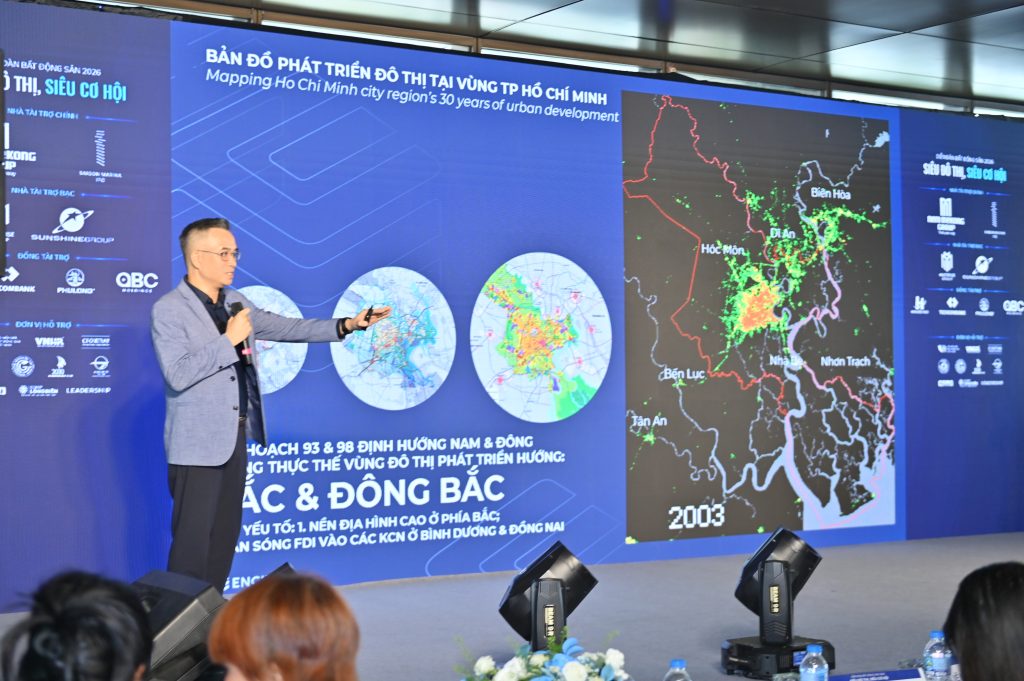
This demonstrates the important role that industry, employment, and capital flows play in shaping urban development. With its large concentration of industrial parks, Binh Duong has built a strong economic foundation and workforce over many years, generating demand not only for industrial real estate but also for housing, retail, services, and products catering to professionals and experts.
Notably, enCity suggests that the northern urban region should evolve into an industrial–technology belt, focusing on R&D, clean manufacturing, high-tech industries, and housing for engineers. From this perspective, Binh Duong should not remain merely an “industrial capital,” but gradually develop into an R&D hub and an urban center for engineers and highly skilled professionals.
This could represent an important transition: from a manufacturing-driven area into an integrated ecosystem combining industry, technology, urban development, services, and high-quality human resources.
Capital Flows and Housing Supply Are Shifting
From a market perspective, CBRE also noted significant changes following the expansion of Ho Chi Minh City’s metropolitan space.
According to data presented at the event, the total industrial land area within the expanded Ho Chi Minh City market increased from approximately 2,500 hectares to 15,500 hectares, representing a 6.2-fold increase.
In the residential market, CBRE observed that capital and housing demand are gradually shifting from the traditional urban core toward new growth poles, with Binh Duong standing out as one of the most prominent markets.
In the first half of 2026, 79% of new apartment supply in the expanded Ho Chi Minh City market came from the former Binh Duong area.
This indicates that housing supply across the mega-city is becoming increasingly decentralized. Areas offering available land, employment opportunities, improving infrastructure, and more accessible pricing than the traditional urban core may play an increasingly important role in accommodating future housing demand.
From a Single-Center City to a Multi-Centered Mega-City
DOIFOTO
CBRE describes the long-term urban development trajectory as:
Single-center city → TOD-linked satellite cities → Multi-centered mega-city.
This transformation is also changing the way real estate value is assessed.
In the past, distance from the city center was one of the most important criteria. In a multi-centered urban model, however, the city will contain multiple employment, commercial, technology, and industrial centers.
These centers will be connected through Metro lines, ring roads, expressways, and public transportation systems.
enCity describes this shift as moving from “kilometers to minutes”: in the future, real estate value will increasingly depend on travel time to employment centers and amenities rather than geographical distance alone.
Lessons from Tokyo, Bangkok, and Shanghai also demonstrate that Metro systems do not increase property values evenly across the entire market. Instead, urban rail primarily redistributes value toward locations with stronger access to employment, commercial activities, and urban amenities.
Binh Duong New City – A Notable Location in the Northern Growth Pole
Against this backdrop, Binh Duong New City is an area worth closely monitoring.
First, Binh Duong New City is located within Binh Duong’s broader economic ecosystem, surrounded by a strong network of industrial parks, FDI enterprises, and a large population of professionals, engineers, and workers.
Second, the area is being positioned within a much broader regional connectivity structure. In CBRE’s infrastructure map, the Suoi Tien – Binh Duong New City Metro line is shown as part of the future urban railway network of the expanded Ho Chi Minh City.
If the Metro system and regional transport infrastructure are implemented in a coordinated manner, Binh Duong New City has the potential to evolve from an administrative and urban center of Binh Duong into a major northern urban growth pole directly connected with other economic centers across Ho Chi Minh City.
This also reflects the logic of Transit-Oriented Development (TOD), where residential, retail, office, and service developments are concentrated around major public transportation hubs.
CBRE notes that areas within approximately 500 meters to 1 kilometer of railway stations or major transport hubs may experience a revaluation as high-density mixed-use developments integrating Retail – Office – Residential functions emerge.
However, proximity to a Metro line alone does not automatically guarantee property appreciation. Infrastructure progress, TOD implementation mechanisms, project legal status, and the ability to generate genuine end-user demand remain essential factors to consider.
From “Short-Term Speculation” to Value Investing
One of CBRE’s key messages to investors is the need to shift from a “short-term speculation” mindset toward “value investing.”
Investors should pay greater attention to rental potential, genuine local economic growth, infrastructure implementation, project legal status, and developer credibility. Priority should also be given to areas that directly benefit from major transport infrastructure such as Metro lines, Ring Road 3, Ring Road 4, expressways, and other key transportation projects.
The two presentations at the “Super City, Super Opportunities” event suggest that future opportunities will not come from the entire real estate market appreciating uniformly. Instead, the key will be identifying locations where employment – population – infrastructure – public transportation – commercial services – and legal certainty come together.
With its established industrial foundation, large concentration of FDI enterprises, and future Metro connectivity, Binh Duong – particularly Binh Duong New City – is one of the areas worth watching as the northern growth pole of the Ho Chi Minh City mega-region continues to take shape.
This article was compiled by N REAL ESTATE based on information shared at the event organized by TheLEADER Magazine in August 2026.
Other links:
https://vietstock.vn/2026/08/sieu-do-thi-sieu-co-hoi-tu-mo-rong-khong-gian-den-yeu-cau-nang-tam-nang-luc-doanh-nghiep-4220-1484975.htm
https://tphcm.chinhphu.vn/tai-cau-truc-khong-gian-sieu-do-thi-mo-rong-dong-luc-tang-truong-cho-tphcm-101260825192031584.htm
https://m.cafef.vn/gia-trung-binh-toan-bo-thi-truong-can-ho-tphcm-mo-rong-giam-16-trieu-dong-m2-188260826061655198.chn